The design
Stuart Walker designed the park. Stuart has been designing skateparks all over the world for years.
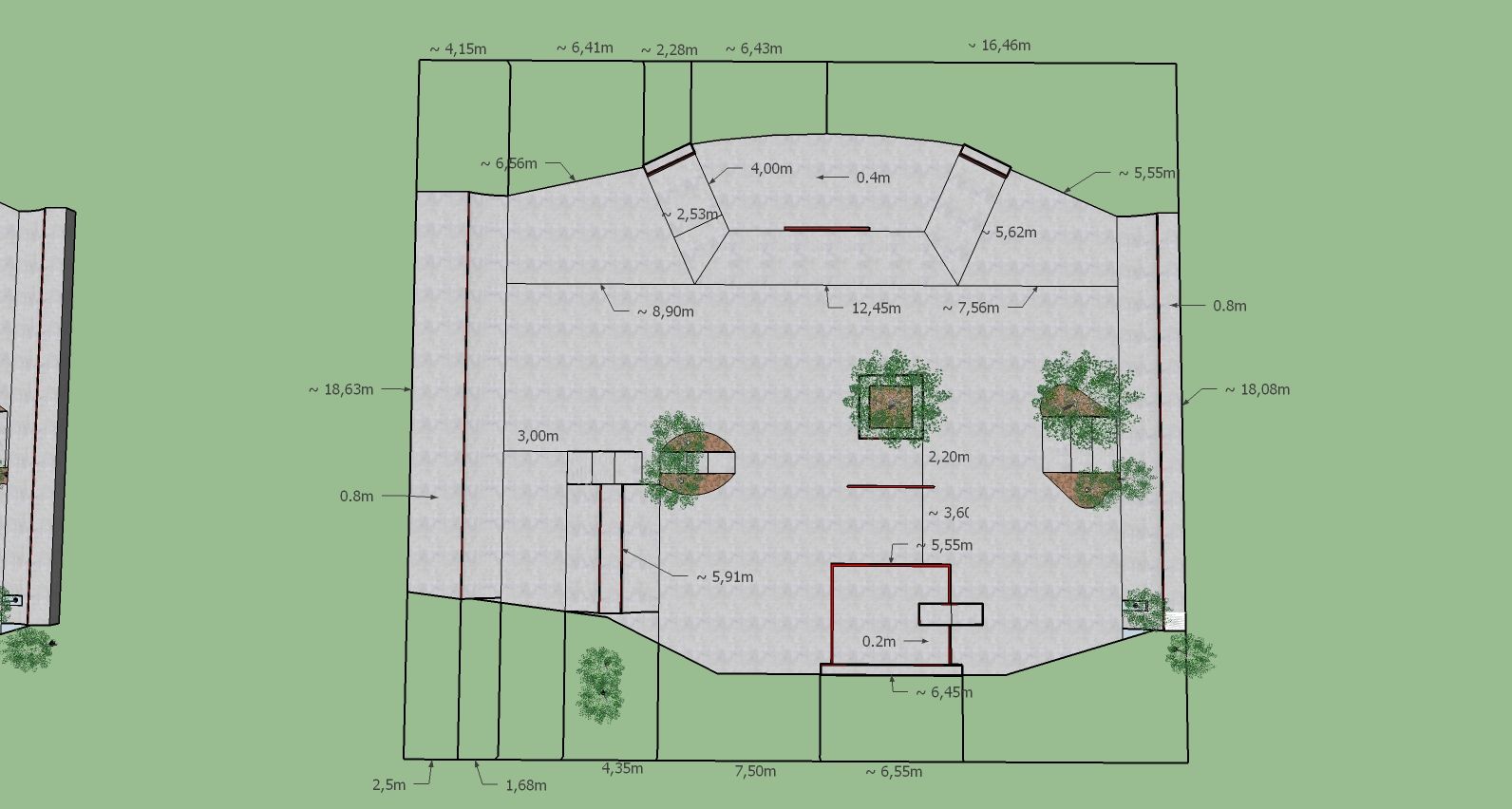
The design covers about 800 m² of concrete. Street features sit in the middle: ledges, a flat rail, a manual pad and a raised platform. Long quarter pipes run down both sides, with a mini ramp beside one of them.
Trees are part of the park. They grow in planters across the slab, with concrete bumps that ride over the planter edges, a ledge you can grind around the central tree, and one tree growing out of a pocket in a quarter pipe.
Lowveld summers are hot, so we'll keep existing mature trees where we can and add shade trees, shade sails and covered seating. We're looking at solar lighting so people can skate on cooler evenings.
- ~800 m²
- of skateable concrete
- 2 × 18 m
- quarter pipes, one down each side
- 9
- features, numbered on the plan below
- Free
- to use, for everyone
The plan
Each number marks a feature on the plan. All dimensions are approximate, and the layout may change a little once it is fitted to the site.
Left quarter pipe
Runs the full left edge, about 18.6 m long, with steel coping on the lip and a flat deck behind it.
Right quarter pipe
Runs the full right edge, about 18 m long. Near its lower end a tree grows out of a pocket cut into the ramp.
Mini ramp
A small quarter pipe with a deck and steel coping, facing a lower curved bank. About 3 m wide.
Left planter
An oval tree bed with wave-shaped concrete bumps that roll over its edge.
Right planter
A tree bed with a concrete bump draped over the edge.
Planter ledge
A square brick planter round a central tree. Its wide, steel-edged top is a ledge you can grind on each side.
Flat rail
A free-standing steel rail on five posts, between the planter ledge and the manual pad.
Ledge, rail and manual pad
A low pad edged in steel, with a brick ledge along the back and a small box with a sloped run-up on top.
Raised platform
A flat-topped platform against the curved top edge, with banks down the front and both sides, a low steel curb and coped corner blocks.
Views
Working renders from Stuart's 3D model. Select a view to see it full size. Numbers refer to the plan.
From behind the raised platform, looking back across the park. From the left side, over the long quarter pipe and the mini ramp. The planter ledge, the flat rail and the manual pad. The right planter bump, and the tree growing out of the quarter pipe. The mini ramp, the left planter bumps and the left quarter pipe. The raised platform, with its curb and corner blocks.
The site
Photos of the site, taken in November 2026. The design will be fitted to it, and we'll keep existing mature trees where we can.
Why a skatepark
Hoedspruit is a base for visitors from across South Africa and the world on their way into the Greater Kruger. For the children and teenagers who live here, and in the communities around the town, the options are much thinner.
Few places offer young people something active and affordable to do after school, and there is no public space where they can turn up with a board, a bike or a pair of skates and ride.
Skating is exercise that young people choose for themselves. It builds balance, coordination, strength and stamina, and kids do it because they enjoy it. You don't need a team, a coach, a training schedule or a fixture list. You turn up alone or with friends and skate at your own pace.
Most organised sport costs money before you start: registration fees, transport, uniforms and coaching. Skating needs a board, but a public park removes the biggest barrier, which is having somewhere to skate. That counts most for young people in the rural and lower-income communities around Hoedspruit.
Skating is also hard. Even a simple trick takes many attempts, plenty of falls and a fair amount of stubbornness before it lands. Kids who stick with it learn to judge risk, handle setbacks and work out problems on their own, and they take those lessons with them when they leave the park.
Skateparks become social spaces without anyone planning it. Ten-year-olds and forty-year-olds skate the same ramps, watch each other, swap advice and cheer when someone pulls off a trick they've been trying hard to land. In a region where distance and money still keep communities apart, a shared space where those lines matter less is worth building.
Where your money goes
Your donation goes towards the things that decide whether a skatepark lasts: good concrete, proper drainage, steel coping and rails, and the shade, lighting and seating that make people want to stay. The concrete and steel alone come to:
| ~800 m² | Concrete for the floor and ramps, poured 10 to 15 cm thick |
|---|---|
| ~800 m² | Welded steel mesh to reinforce all of it |
| 91 m | Steel tube and angle iron for coping, rails and ledge edges |
| 321 | Steel bars to tie the slabs together |
| Formwork | Timber and plywood to shape the ramps |
After it opens
A good skatepark gives young people somewhere to belong, somewhere to push themselves and somewhere to spend their free time. Parents and caregivers can sit in the shade while their kids skate. Visitors staying in town get one more thing to do.
Once the park is open, we hope it can host much more: beginner clinics, school holiday programmes, girls' skate sessions, equipment donations for kids who can't afford a board, and outreach to the communities around Hoedspruit.
How you can help
Donate
Donate what you can, and share the campaign with anyone interested in supporting the park.
Donate on BackaBuddySponsor or supply
If you run a business that would like to sponsor the park, or can donate materials or professional services, we'd love to hear from you.
Email usShare
Send this page to anyone interested in supporting the park.
Thank you for helping us build it.